
Half a Century as an Organist
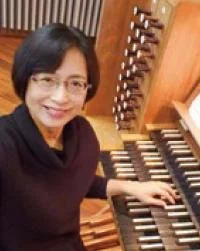
Miwako HORII
Former Aoyama Gakuin Universy Organist
Every time I sit at the organ bench, I force myself to "be brought back” to God. From where!? From far from God. When I face the organ, I am inevitably brought before the Lord. And I am asked, "Where exactly are you (or were you)?"
Playing music for worship is no easy matter. It’s more than just a venue for displaying technical ability. Because it is a place for us to worship and to uphold the congregation in prayer and praise. One’s faith and way of life are called into question. From a musical standpoint, sufficient technical skill and musicality are also required. But because things rarely go exactly as ideally as we imagine, prayer is essential:
"Lord, help me..."
In 1974, during my first year at Aoyama Gakuin University, I was appointed as the university organist. In May of that year, driven solely by the desire to study the organ under Professor Koten Okuda of the Faculty of Theology, I essentially “invited myself” to become his student. I began with lessons on the reed organ, and by July I had moved on to the pipe organ. Then, in September, my ability was recognized, and I was recommended to take charge of the weekly worship service once a week. For someone like me, who had not the slightest trace of ambition, this was an entirely unexpected development. Looking back now, the fact that I ended up serving for fifty years can only be described as God’s mysterious guidance and abundant grace. It was miraculous that I was entrusted with such responsibility while still a beginner, and fifty years—though said in a single phrase—contained countless events.
Reflecting on my teenage years, they were a time of discovering the organ and practicing with utter abandon. I jumped in without understanding anything, and simply being able to play the organ—without knowing its meaning or value—was pure joy. In 1975, at Professor Koten Okuda’s instruction, I was assigned as accompanist for the Oratorio Society Choir in the university. I began sight-reading the accompaniments for works like Messiah and Bach’s Passion settings, and this too was exhilarating; I threw myself into it wholeheartedly. Then in 1978, again at Professor Koten Okuda’s urging, I auditioned—hesitantly—for the position of Tokyo Union Church organist. I passed, and was appointed. Because it was an American church, a formal contract was drawn up; it was a “job” in the official sense. This was during my senior year in the university. Around that time, I began to struggle with my future path. Although I was enrolled in the French Literature Department, my passion for music far outweighed my academic interests. Yet I could not go against my father, who insisted, “After graduation, you must get a job.” So, I became a university staff member. Still, the desire to “study the organ properly” became impossible to suppress, and after a year and a half I resigned. Six months later, I entered the special program in pipe organ at Tokyo University of the Arts.
My twenties were a period of voracious study. I sight-read everything I could get my hands on—from Baroque to contemporary works—focusing on refining my technique and deepening my musicality. I felt as though “the future stretched out infinitely before me.”
My thirties were filled with energetic performance activities, even while raising children. I accepted any work that came my way, and the opportunity to collaborate with many conductors, soloists, choirs, and orchestras became a precious treasure. The Tokyo Union Church was home to Christians of many nationalities, and I encountered a wide variety of forms of praise. While the repertoire was mostly orthodox, contemporary works, jazz-influenced pieces, folk-style music, and Taizé chants were also incorporated. This nurtured flexibility and expanded my expressive palette. I also enjoyed the blessing of sharing faith with Christians across borders. Yet despite the richness of that period, I was extremely busy and often exhausted. It was also a time when I came to know the harshness of the musical world. Surrounded by so many talented people, I frequently wondered, “What can I possibly offer?” Feelings of doubt, anxiety, and even discouragement visited me more than once.
My forties brought an unexpected crisis in my private life. I was plunged into the depths. As a result, I found myself raising two children on my own, facing severe financial hardship. Amid this, through a conversation with a Pastor, I was suddenly confronted with the fundamental reality of my own sin, and I was shattered. How arrogantly and self-centeredly I had lived, imagining that I had achieved everything by my own strength, without truly acknowledging God as God! Struck by the realization that Christ had gone to the cross for someone like me, I collapsed in tears. Overwhelming love and forgiveness pressed upon me, and the crucified Lord became “mine” in that moment. Although I had been baptized at eighteen, I had not truly understood the cross as something that concerned me personally. The hardships of daily life continued for a long time afterward, but the fact that I did not collapse entirely and was able to keep walking was, in a sense, a “miracle.” I received a lot of help from those around me. My two children grew up with remarkable resilience and sincerity. Needless to say, behind this was the Lord’s deep mercy and protection.
In my fifties, I experienced a series of physical ailments. I came to realize that “life is short, and one cannot do everything,” and at the same time, death became something I could sense more closely. I felt anew, and more deeply, that life, health, family, and music—all of it—is grace given by God. As I came to understand that my own strength was no longer reliable, unnecessary striving naturally fell away. I was able to let go of desire and vanity, and my way of life was transformed into one marked by the assurance of being accompanied by the living Lord.
In my sixties, I finally began to see clearly the path I was meant to walk, and I was able to proceed with calmness. I now believe that even those painful trials were necessary for me. Through them, my faith and character were disciplined and strengthened. As Hebrews 12:11 says, “No discipline seems pleasant at the time, but painful. Later on, however, it produces a harvest of righteousness and peace for those who have been trained by it.” And recently, I feel that I have begun—just a little—to understand the mystery of “Christ dwelling within,” that is, “It is no longer I who live, but Christ who lives in me” (Galatians 2:20). What grace this is.
God’s plan far surpasses human thought. There were times when I was led in completely unexpected directions, and times so painful that I wondered whether God was silent. Yet looking back, I see that the Lord was always helping me in some way. I have a past I wish I could erase, failures I am ashamed of, and wounds deep within my heart. But I “forget what lies behind,” and trust that the Lord will lead me to completion; I simply run toward the goal (Philippians 3:12–14). I retired from the university this March, but “this is not the end.” There is no end to music—nor to art. Until the end of my earthly life comes, I want to continue receiving God’s true love and forgiveness with gratitude, praising the Lord through music, and walking freely along this journey as He leads.
Source: Aoyama Gakuin University Bulletin 288 in June 2024.
(Originally written in Japanese. English translation authorized by the author in July 2026.)